A metropolis made up of many towns: what sets the Oaxaca Metropolitan Area apart
In this article
- It Is Not a City Surrounded by Suburbs
- The Center Continues to Exert Its Gravity
- Five kilometers can change almost everything
- Geography Is Not the Whole Story
- A single real estate market would be a convenient fiction
- What Complicates It Also Preserves Its Character
- How Bonimmo Wants to Help
- Sources consulted
A look at the Oaxaca Metropolitan Area as a network of municipalities and communities with distinct identities, services, and property regimes—and why that complexity is also what makes it special.
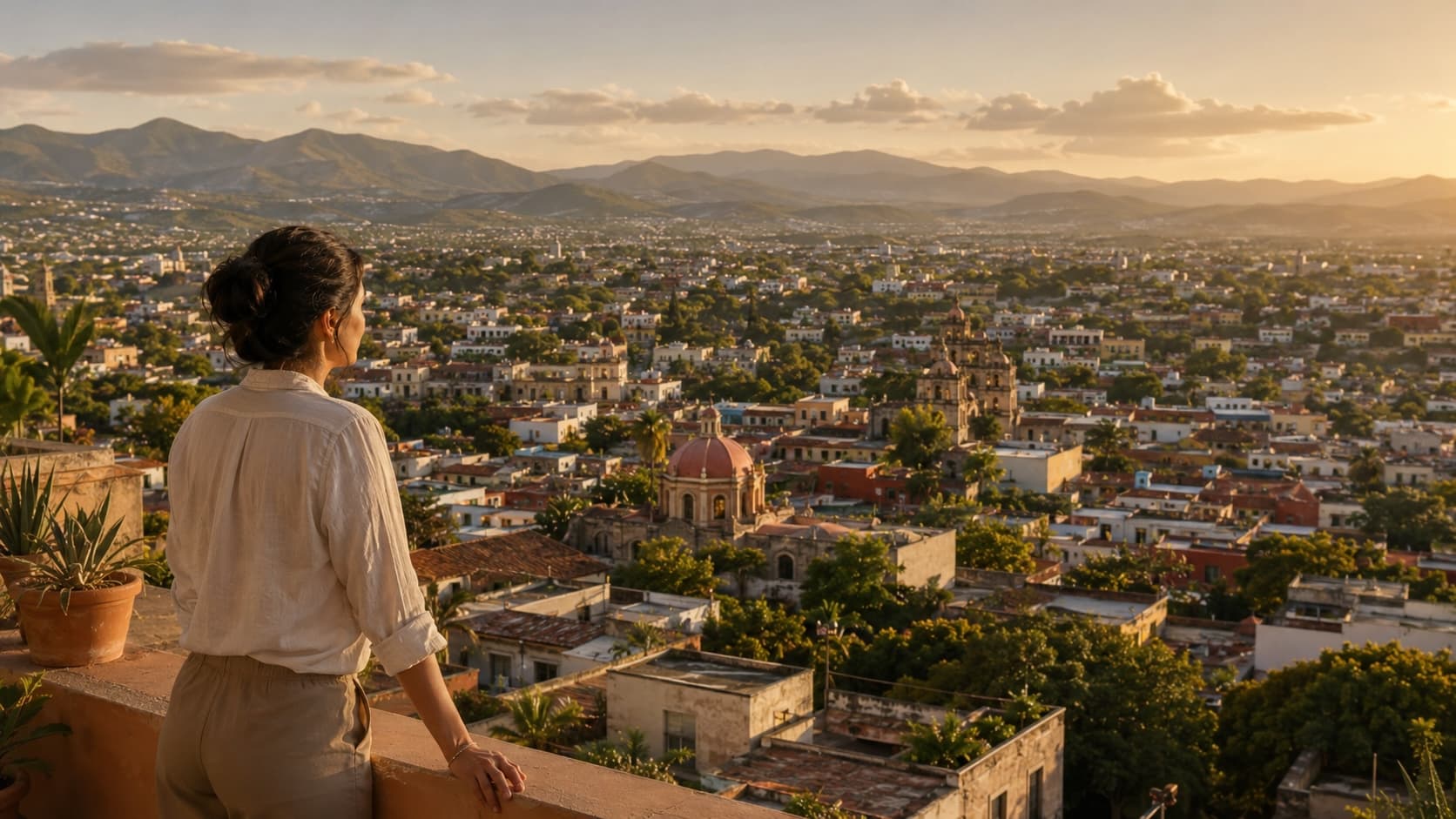
You can leave downtown Oaxaca, travel a few kilometers, and feel as if you never left the city. Yet you may have crossed into several municipalities: the local government, some services, urban regulations, and perhaps even the legal status of the land have changed—even though no sign warned you of it.
The Oaxaca Metropolitan Area officially comprises 27 municipalities and more than 737,000 residents. Its most recent land-use planning program aims to address more than three decades of neglect in planning and coordination.
Oaxaca didn’t become a metropolis because its towns disappeared. It became a metropolis because urban expansion ended up connecting them without completely erasing their boundaries, identities, or ways of relating to the territory.
That is where much of its complexity lies. And also what makes it special.
It Is Not a City Surrounded by Suburbs
The simplest model for imagining a metropolis is a central city that grows outward through neighborhoods, housing developments, and commercial corridors.
Oaxaca has all of that, too. But the expansion did not occur on empty land.
Around Oaxaca de Juárez, there were already towns with their own centers, markets, authorities, and organized land holdings. The city eventually reached them and connected them—not necessarily replacing them.
Oaxaca grew around, over, and within communities that already had their own way of life.
That is why the urban sprawl may appear continuous, while local life changes from one municipality to the next. The conurbation physically unites these areas, but it does not standardize them.
This makes it difficult to coordinate road networks, water, waste management, transportation, and growth. It also prevents the entire metropolitan area from becoming an indistinguishable succession of new developments.
The Center Continues to Exert Its Gravity
Expansion did not diminish the influence of the historic center.
UNESCO notes that the center of Oaxaca continues to be a hub of economic, political, social, religious, and cultural activity. It is not merely a heritage site: it remains a place of work, commerce, protest, celebration, and daily life.
Many routes still lead to this small area, increasing pressure on streets designed for a different scale.
Oaxaca has spread into many municipalities while continuing to revolve around a small core.
That is why a nearby property can feel far away at certain times, and location cannot be understood solely in terms of kilometers.
Five kilometers can change almost everything
In some cities, five kilometers mean moving to a different neighborhood.
In Oaxaca, it can mean moving to a different municipality—with a different water system, access, transportation, governing authority, property regime, and conditions for conducting a transaction.
The Land Use Planning Program examines urban structure, infrastructure, mobility, risks, and property types separately. None of these variables can be deduced simply by looking at a pin on a map.
For those who want to live here, this changes their daily routine. For those who want to invest, it changes the risk.
Two plots of land of the same size and price may offer different possibilities depending on documentation, access, utilities, permitted use, and relationship with the community. Two nearby houses may rely on different routes or water supplies.
In Oaxaca, asking “Where is it?” is rarely enough. You have to ask, “Within which territory does it operate?”
Geography Is Not the Whole Story
The Central Valleys lie in a depression between mountain ranges. The beauty of the valley also influences where the city expands, how it connects, and which areas face slopes, runoff, or other risks.
Historical architecture also bears signs of adaptation to a seismic region: low-rise buildings, solid structures, and thick walls.
Geography can visually shorten distances and lengthen them in practice when there are few thoroughfares, heavy rain, construction, or traffic.
When evaluating a property, it’s advisable to check access routes at different times of day, utilities, land conditions, and risks that require expert advice.
A single real estate market would be a convenient fiction
Talking about the “Oaxaca real estate market” in the singular makes for an easy conversation, but it hides too much.
A home in the city center, a house in a suburban municipality, a plot of land undergoing urban transition, and a property within a community under an agrarian regime do not compete on equal footing.
Nor do those who want to walk to restaurants, those who need to commute to an office daily, those who wish to develop the property, and those buying to preserve capital all seek the same thing.
A useful comparison requires more context than just price and square meters:
- municipality and locality;
- access routes and actual travel times;
- water and utilities;
- surroundings and nearby uses;
- documentation and legal status;
- ease of renting, developing, or reselling later.
This doesn’t mean that every difference is a problem. It means that the opportunity depends on understanding it.
Oaxaca rewards those who ask a second question and may penalize those who assume that two nearby locations function the same way.
What Complicates It Also Preserves Its Character
It would be easy to romanticize fragmentation and say that disorder is part of the charm. That’s not the case.
The lack of coordination has costs: uneven services, difficult mobility, growth in unsuitable areas, and uncertainty for residents, property owners, and investors.
But the solution shouldn’t be to erase the differences between communities either.
That very diversity allows places with recognizable rhythms, celebrations, and neighborly relationships to still exist. In just a few kilometers, you can go from the historic center to a town with its own identity, a residential area, fields, and mountains.
The fragmentation that complicates life in Oaxaca has also prevented all its places from ending up looking alike.
Perhaps that is why so many people fall in love with it. Not just because of its buildings, food, or climate, but because it still offers a metropolitan lifestyle with a sense of local history and a rare closeness between the city, the villages, and the surrounding countryside.
The challenge isn’t to make it more uniform.
It’s to learn to function as a single metropolis while remaining a collection of distinct towns.
How Bonimmo Wants to Help
Bonimmo was created, in part, because this complexity is often scattered across ads, conversations, and local knowledge that’s hard to access.
Today, our property catalog lets you gather options, filter them, and compare them. You can save them to favorites and supplement the process with our guide on how to search for a property without spending your whole life on it or the framework for deciding whether to buy or rent a place to live.
Our approach goes beyond simply displaying photos and prices. We want anyone considering living in or investing in Oaxaca to better understand the area behind each listing: municipality, access, services, surroundings, and—when sufficient and reliable information is available—relevant legal status.
Limitation: Bonimmo does not yet cover the entire metropolitan inventory and does not independently verify services, property status, or legal viability. Comparing properties online is a starting point; exploring the area, confirming the information, and seeking professional review remain essential.
Oaxaca doesn’t need another platform that reduces all its properties to dots on a map. It needs tools that help people understand why each dot belongs to a different context.
Explore available properties in Oaxaca and start comparing their contexts on Bonimmo.
Sources consulted
Consultation conducted in August 2026.

Carlo Spada
Fundador de Bonimmo