Buying or Renting a Home: How to Decide What's Really Best for You
In this article
- Buying or Renting a Property: How to Decide What’s Really Best for You
- 1. Start with the time frame, not the monthly payment
- 2. Compare Similar Homes
- 3. Don’t Compare Rent to a Monthly Mortgage Payment
- 4. Protect Your Liquidity
- 5. Value Flexibility and Control
- 6. Separate Your Home from Your Investment
- 7. In Oaxaca, location can vary more than price
- 8. Put Your Decision Through a Stress Test
- So, which is better: buying or renting?
- How Bonimmo Can Help You
- Sources consulted
Buying or Renting a Property: How to Decide What’s Really Best for You
A practical guide to comparing time, liquidity, total cost, and flexibility before deciding where to live in Oaxaca—or almost anywhere in Mexico.
Few decisions elicit such quick advice as this one.
“Renting is a waste of money.”
“Buying ties you down for twenty years.”
“A house always goes up in value.”
“Better to rent and use the rest to invest.”
All of these statements may contain some truth. None of them is enough to make a decision.
A home is, at the same time, the place where you’ll live, one of your most significant expenses, and—if you buy—an asset that you won’t always be able to sell quickly. That’s why comparing rent solely to a monthly mortgage payment leaves out a lot of what really matters.
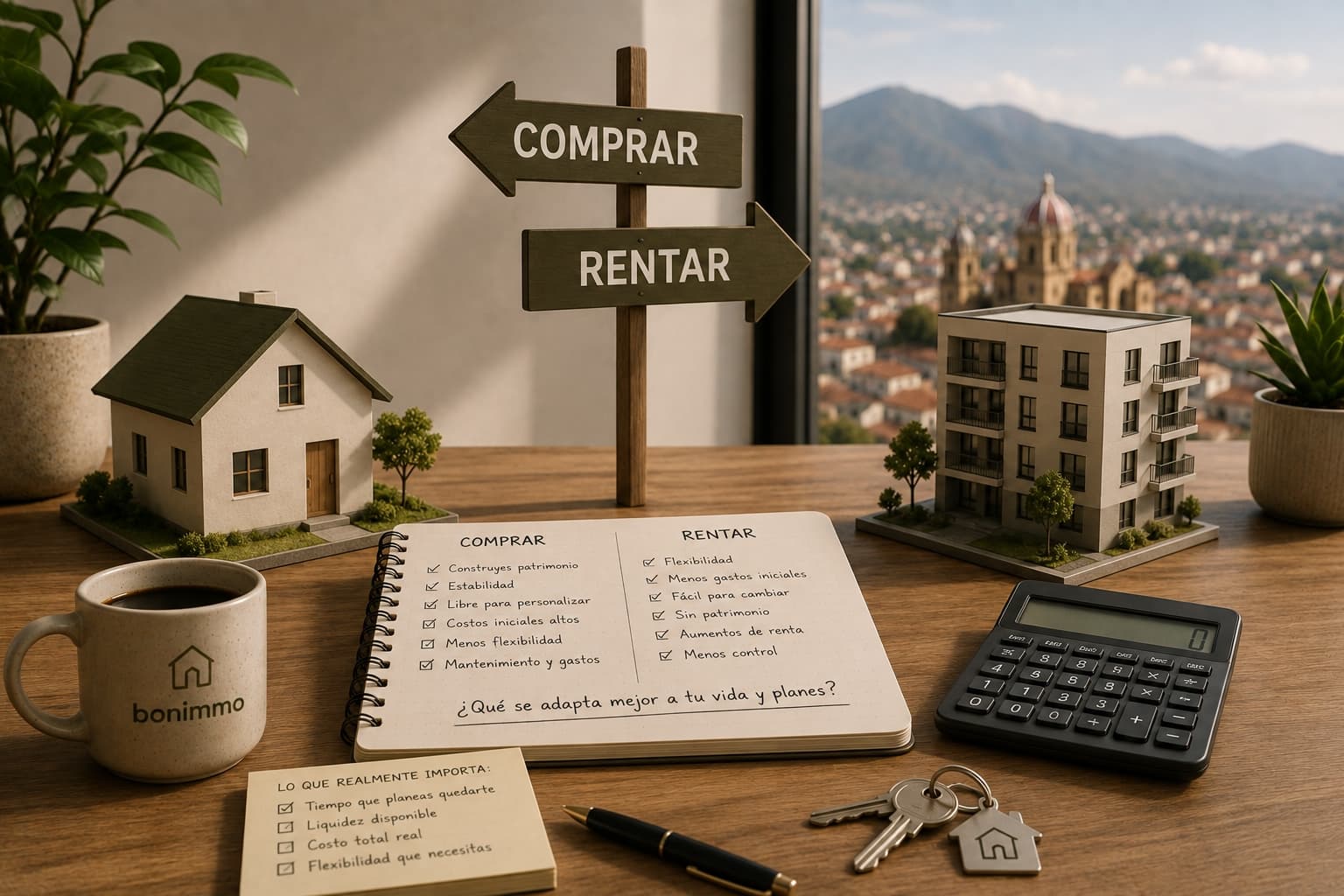
Buying doesn’t always mean moving forward, and renting doesn’t always mean wasting money. The best option depends on how long you plan to stay, the liquidity you’ll retain, the total cost of each alternative, and how much you value flexibility.
You don’t need to guess what will happen to the market over the next twenty years. You need to understand what would have to be true for each option to work in your case.
1. Start with the time frame, not the monthly payment
Before shopping for a mortgage, ask yourself:
How long is it reasonable to expect that I’ll stay in this property, in this area, and in this city?
Buying involves upfront costs, paperwork, and an exit process. If you change jobs, move to a different city, or your family’s needs change sooner than expected, selling can take time and cost money.
Renting usually allows you to adjust course more easily. Buying tends to benefit more from stability.
There’s no universal number of years beyond which buying is “always the right choice.” The break-even point depends on the price, your credit, closing costs, maintenance, comparable rent, and how the property’s value changes.
Instead of looking for a magic rule, imagine three scenarios:
- You stay as long as you expect to today;
- You need to move out much sooner;
- you end up staying much longer.
If buying only makes sense in the most optimistic scenario, the decision is fragile.
2. Compare Similar Homes
A common comparison pits a moderate rent against the monthly payment for a much larger, newer, or better-located property.
That’s not comparing renting versus buying. It’s comparing two different standards of living.
Consider properties that would meet a similar need:
- comparable neighborhood and commute time;
- sufficient size for the same life stage;
- similar conditions and amenities.
If you’re currently renting a two-bedroom apartment and are considering buying a house with a yard, a home office, and three parking spaces, the difference isn’t just about buying. You’re also choosing more space and a different living experience.
First, compare different ways of living in a similar home. Then decide if you want to pay for a different kind of home.
If you’re still gathering options, you can start with our guide on how to search for a property without spending your whole life on it.
3. Don’t Compare Rent to a Monthly Mortgage Payment
This is the key mistake.
A monthly mortgage payment may include principal, interest, insurance, and other fees. The portion allocated to principal reduces the debt and helps build equity; interest, insurance, and fees are financing costs.
That’s why not the entire monthly payment is “wasted,” but not all of it goes toward building equity either.
When renting, consider:
- rent and potential increases;
- maintenance and utilities not included;
- moving and hiring costs;
- improvements you won’t recoup;
- the security deposit, distinguishing between tied-up funds and an amount that will not actually be refunded.
When buying, consider:
- notary fees, registration fees, appraisal costs, taxes, duties, and commissions;
- interest and insurance;
- property taxes, fees, maintenance, and repairs;
- the cost of selling if your plans change;
- the return you forgo on the money used up front.
The down payment deserves clarification: it doesn’t disappear like rent. It becomes part of the value you hold in the property. However, it is no longer available for emergencies or other projects, and recovering it usually requires selling or refinancing the property.
To compare loans, review the monthly payment, the term, the down payment, the total payment, and the Annual Percentage Rate (APR). The Bank of Mexico uses the ATC as a standardized measure of financing costs and expenses. Even so, the ATC describes the loan itself; it does not, on its own, include all the costs of homeownership.
The useful question isn’t:
“Does a mortgage cost less than rent?”
It is:
“What is the total cost of living under each option, how much equity could I build, and what risks would I have to take on?”
4. Protect Your Liquidity
Just because you can come up with the down payment doesn’t necessarily mean you’re ready to buy.
After the initial down payment, ask yourself:
- How much cash do I have left?;
- Could I cover a major repair?;
- What would happen if my income dropped for a few months?;
- Would I still be able to meet my other obligations?
Loan approval is based on a financial institution’s criteria. It does not replace your own budget.
This matters even more when your income is variable, you’re self-employed, or you rely on commissions. A monthly payment that’s manageable in a good month can become a burden during a normal month.
Running out of cash to buy a home doesn’t necessarily increase your security. Sometimes it just changes the nature of the uncertainty.
Renting also requires savings for security deposits, moving expenses, and rent increases. The difference is that it typically ties up less capital from the start.
5. Value Flexibility and Control
Renting can make it easier to move to a different neighborhood, get closer to a new job, or test out an area before committing. In exchange, you have less control over renovations, rent increases, modifications, and the continuity of the lease.
Buying offers greater control over the space and can provide long-term stability. It also makes you responsible for repairs and for a property that you may not be able to sell when you want or at the price you expect.
For someone who plans to stay in the same area for years and has a stable income, control can be a deciding factor.
For those who are still figuring out where they want to live, are expecting career changes, or need to keep capital available, flexibility may be worth more than immediate home ownership.
Not every benefit fits into a spreadsheet. But it should factor into the decision.
6. Separate Your Home from Your Investment
Buying a home to live in can be a good decision even if it doesn’t turn out to be the investment with the highest possible return.
It can also be a bad financial decision even if the property is beautiful.
A home provides you with daily benefits: location, stability, space, privacy, and quality of life. That value is real, even if it doesn’t show up as a return.
If you want to evaluate the purchase as an investment, do so separately. Ask yourself:
- What net rental income could it generate?
- How long might it remain vacant?
- What maintenance, taxes, and management costs would it require?
- How easy would it be to sell?
- what would need to happen to its price to meet your goal.
Capital appreciation can help, but it’s not wise to treat it as a guarantee that justifies any price.
A good home and a good investment can go hand in hand. They’re not the same thing.
7. In Oaxaca, location can vary more than price
Two properties that are close together on a map can offer different experiences and carry different risks.
In addition to price, check:
- actual travel time;
- access at different times of day and seasons;
- water supply and storage;
- available services;
- noise, area development, and nearby land uses;
- property status and documentation.
If you’re buying, confirm whether the property is privately owned, ejidal, or communal, and seek notarial or agrarian advice when appropriate. The property regime can affect what can legally be transferred and the necessary procedures.
If you’re renting, review the lease agreement, maintenance responsibilities, security deposit terms, restrictions, and who is responsible for repairs.
A cheaper, more remote home could cost you hours of commute time. A higher rent might include utilities that lower the total cost. An attractive purchase may require a much more thorough review of the documentation.
8. Put Your Decision Through a Stress Test
Before making a decision, consider changing some of the conditions.
What would happen if you needed to move sooner, your income temporarily decreased, a major repair came up, or the property took a long time to sell?
This isn’t about imagining a catastrophe. It’s about making sure the decision doesn’t depend on everything going perfectly.
Buying starts to make more sense when:
- you expect to stay for a sufficiently long period;
- your plans are relatively stable;
- you retain liquidity after the initial outlay;
- you can cover the total cost, not just the monthly payment;
- you value control and stability;
- the documentation allows for a secure transaction.
Renting starts to make more sense when:
- your plans might change;
- you’re still getting to know the area or your needs;
- buying would use up almost all your savings;
- you value mobility and flexibility;
- the sunk cost of buying is high compared to a comparable rental;
- you’d rather not take on repair costs or the risk of selling just yet.
Don’t count how many bullet points each option gets. Use them to figure out which assumption is driving your decision.
So, which is better: buying or renting?
The honest answer is that neither option wins by definition.
Buying can help you build equity, gain stability, and have greater control over your home. Renting can protect your liquidity, give you flexibility, and prevent you from committing before you fully understand your needs.
The best decision is one that:
- compares equivalent homes;
- considers the total cost;
- leaves financial wiggle room;
- works over a reasonable time frame;
- withstands potential changes;
- fits the life you actually lead.
You don’t need to prove that buying is better than renting or that renting is the smarter choice. You need to avoid letting someone else’s opinion dictate a decision that you’ll have to live with.
How Bonimmo Can Help You
In the Bonimmo catalog, you can explore properties for sale and rent to compare what each option offers within the same areas and price ranges. You can save options to your favorites and use the calculator to estimate purchase scenarios before confusing a possible monthly payment with a sound decision.
Limitation: A calculator organizes assumptions; it doesn’t know your job stability, your family plans, your risk tolerance, or all the specific costs involved in a transaction. Its results are estimates and do not replace a formal quote, a financial review, or professional advice.
Our goal is for Bonimmo to help you make informed comparisons before making one of the most important financial and personal decisions of your life.
Not to tell you to buy.
Not to convince you to rent.
To help you understand what would need to be true for either option to work.
Compare different scenarios using the Bonimmo calculator.
Sources consulted
Consultation conducted in August 2026.

Carlo Spada
Fundador de Bonimmo